May 5, 2026
“Law Notes: Tort Laws; part 1” an article by Ronald Rodriguez
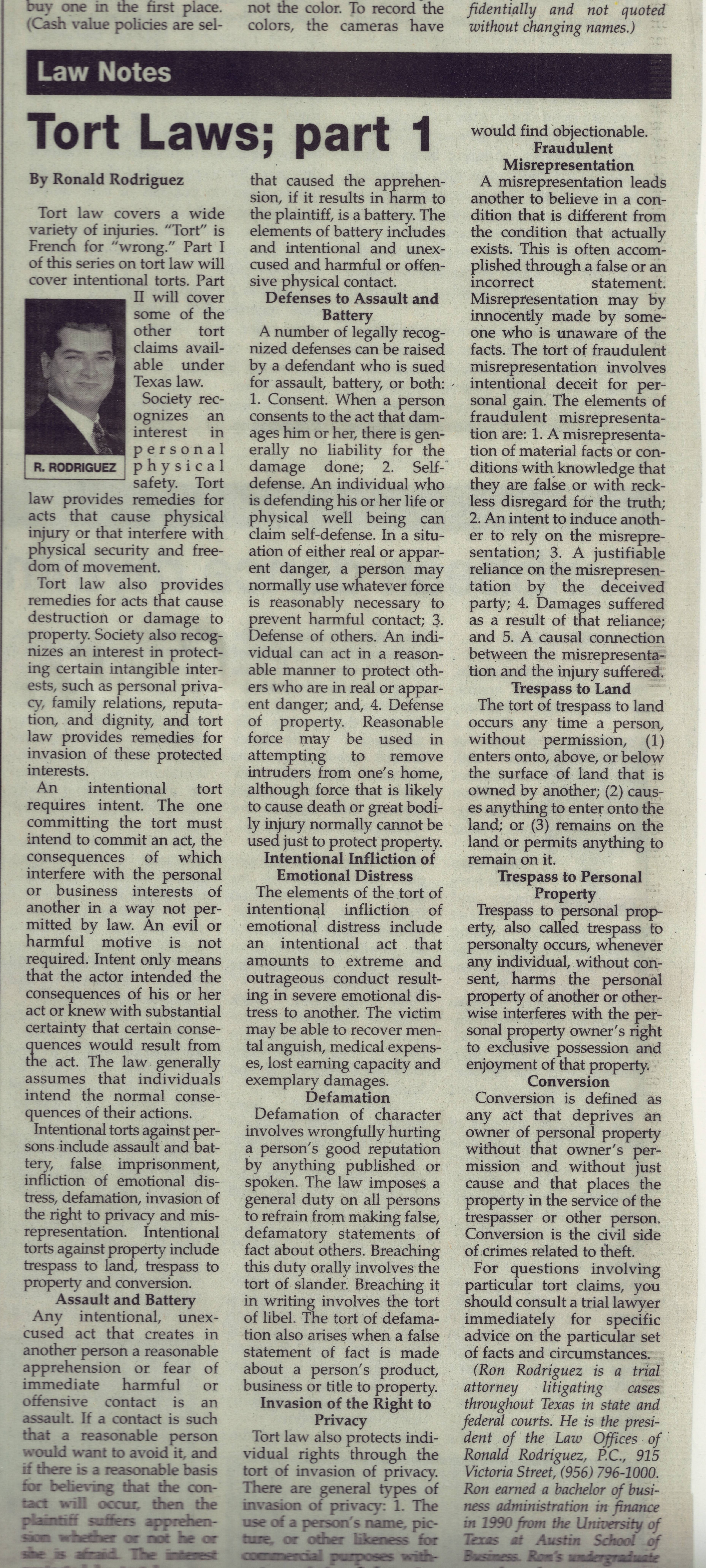
Law Notes: Tort Laws: Part 1
By Ronald Rodriguez, Laredo Morning Times
Tort law covers a wide variety of injuries. “Tort” is French for “wrong.” Part 1 of this series on tort law will cover intentional torts.
What is a Tort?
A tort is a civil wrong that causes injury or harm to another person. Tort law provides remedies for individuals who have suffered injury due to the wrongful conduct of others.
Tort law aims to:
- compensate victims for their injuries
- hold wrongdoers accountable
- deter harmful conduct
Intentional Torts
Intentional torts occur when a person acts with the intent to cause harm or with knowledge that harm is substantially certain to result.
Some common intentional torts include:
- assault
- battery
- false imprisonment
- intentional infliction of emotional distress
Assault and Battery
Assault is the intentional act that creates a reasonable apprehension of imminent harmful or offensive contact.
Battery occurs when harmful or offensive contact actually happens.
These claims do not require serious physical injury. Even minimal contact may be sufficient if it is offensive or unwanted.
False Imprisonment
False imprisonment occurs when a person is unlawfully restrained or confined without consent.
This can happen without physical force. Threats, coercion, or other means of restriction may be sufficient.
Intentional Infliction of Emotional Distress
This tort occurs when someone engages in extreme and outrageous conduct that causes severe emotional distress to another person.
The conduct must go beyond ordinary rudeness or insults.
Defenses to Intentional Torts
Several defenses may apply in intentional tort cases, including:
- consent
- self-defense
- defense of others
- defense of property
These defenses may limit or eliminate liability depending on the circumstances.
Damages in Tort Cases
A person who proves a tort claim may recover damages for:
- medical expenses
- lost wages
- pain and suffering
- emotional distress
In some cases, punitive damages may be awarded to punish particularly harmful conduct.
Final Note
Tort law is broad and fact-specific. Each case depends on its unique circumstances.
If you believe you have been injured due to someone else’s actions, you should consult an attorney to evaluate your rights.
About the Author: Ronald Rodriguez
Ronald Rodriguez is a nationally recognized Texas personal injury trial and appellate attorney, legal educator, and author whose career has been defined by major verdicts, appellate victories, and a strong commitment to justice.
Mr. Rodriguez is Board Certified in Personal Injury Trial Law and Civil Appellate Law by the Texas Board of Legal Specialization. This rare dual certification sets him apart. It allows him to not only build powerful cases at trial, but also protect and sustain those results on appeal.
He is also an adjunct professor at the University of Texas School of Law, where he teaches Texas Personal Injury Trial Law. This is the first class of its kind, and his textbook, the Texas Personal Injury Trial Law Handbook, serves as the foundation for the course. His role in teaching future attorneys reflects a deep level of knowledge and leadership in the field.
Mr. Rodriguez is the founder and managing attorney of Texas Personal Injury Experts, PLLC, a leading personal injury law firm with offices in Austin and Laredo. The firm represents individuals and families in high-stakes cases involving catastrophic injuries, wrongful death, and complex litigation.
A Proven Record of Results
Throughout his career, Mr. Rodriguez has secured numerous multimillion dollar verdicts and has been involved in some of the most significant cases in Texas.
His results include:
A $281 million jury verdict, one of the largest in Texas
A $47.5 million verdict against a private prison company
Recognition as Trial Lawyer of the Year by the National Public Justice Foundation
Induction into the Texas Lawyer Jury Verdict Hall of Fame
His work has also been featured in major national publications, including The New York Times, The Wall Street Journal, Bloomberg News, Texas Lawyer, and Lawyers USA.
Author of the Texas Personal Injury Trial Law Handbook
Mr. Rodriguez is the author of the Texas Personal Injury Trial Law Handbook, a comprehensive and practice-oriented guide to personal injury litigation in Texas.
The handbook provides a start to finish breakdown of the personal injury process, including:
Case evaluation and early investigation
Medical records and insurance communications
Settlement demands and legal strategy
Discovery and pretrial preparation
Trial presentation and jury charges
Post-trial motions and case resolution
Each chapter includes practical forms and real-world insight, making it a valuable resource for both legal professionals and individuals seeking to better understand their case.
Why His Perspective Matters
What sets Mr. Rodriguez apart is his combined experience in trial law, appellate law, and legal education.
Clients benefit from:
Trial strategies built to withstand appellate review
A deeper understanding of legal procedure and case development
Experience handling high-stakes and complex litigation
Insight shaped by teaching personal injury law at a top law school
This dual perspective allows for a more strategic and comprehensive approach to every case.
Learn From a Lawyer Who Teaches the Law
As a professor at the University of Texas School of Law, Mr. Rodriguez teaches the same concepts he applies in real cases.
This means clients and readers are learning from someone who not only practices law at a high level, but also teaches and refines those principles in an academic setting.
Thinking About Your Next Step
Understanding your rights is the first step. Having the right legal representation can make a meaningful difference in the outcome of your case.
If you or a loved one has been injured in Texas, Texas Personal Injury Experts provides strategic, client-focused representation backed by trial experience and appellate strength.
Call 833-300-0000 for a free case evaluation
No fee unless we win your case