May 6, 2026
“Law Notes: Torts law – Part II” an article by Ronald Rodriguez
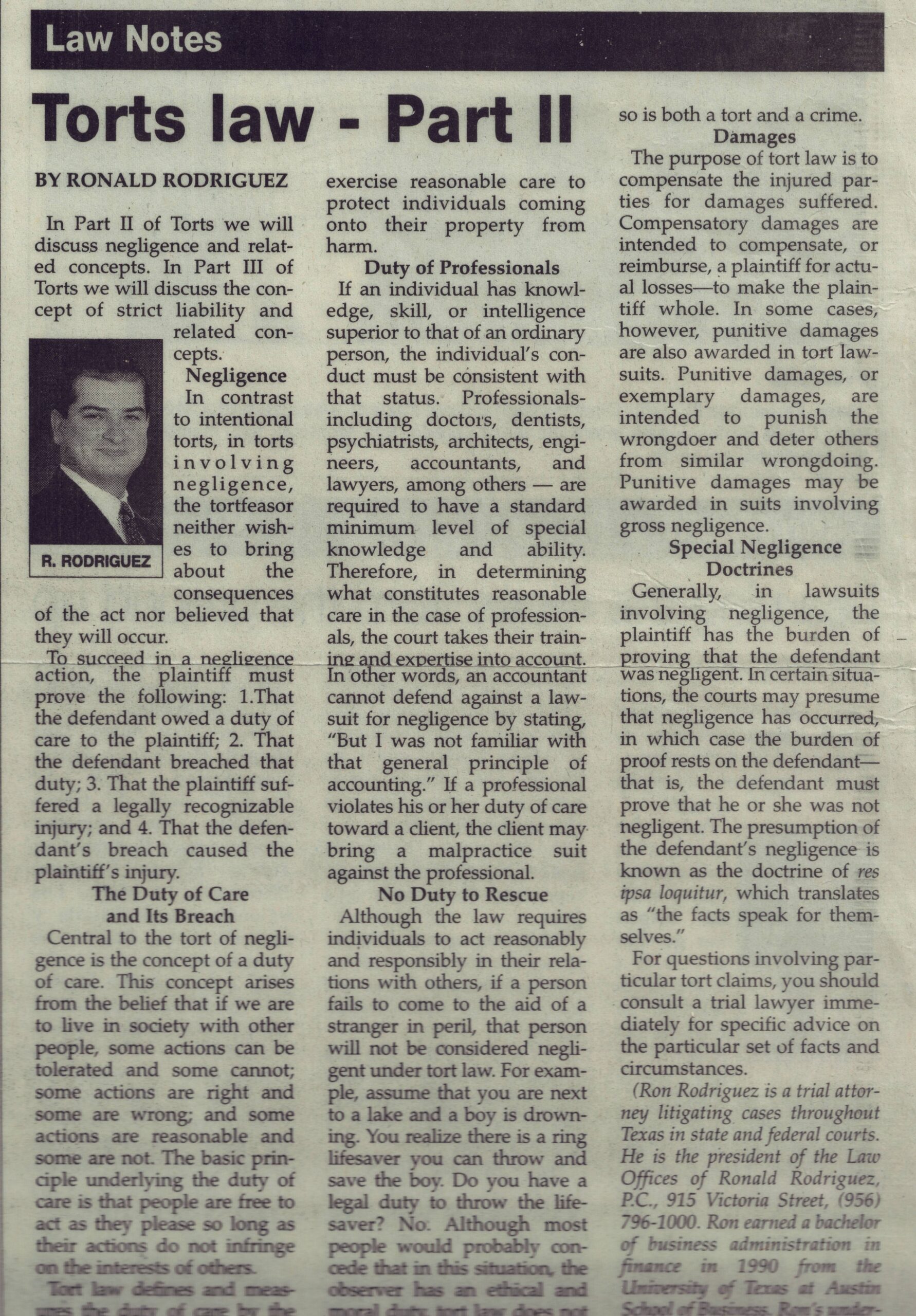
Law Notes: Torts law – Part II
By Ronald Rodriguez, Laredo Morning Times
In Part II of Torts we will discuss negligence and related concepts. In Part III of Torts we will discuss the concept of strict liability and related concepts.
Negligence, in contrast to intentional torts, involves neither willfulness nor the desire to bring about the consequences of the act nor belief that they will occur.
To succeed in a negligence action, the plaintiff must prove the following:
- The defendant owed a duty of care to the plaintiff
- The defendant breached that duty
- That the plaintiff suffered a legally recognizable injury
- That the defendant’s breach caused the plaintiff’s injury
The Duty of Care and Its Breach
Central to the tort of negligence is the concept of a duty of care. This concept arises from the belief that if we are to live in society with other people, some actions can be tolerated and some cannot; some actions are right and some actions are wrong. The basic principle underlying the duty of care is that people are free to act as they please as long as their actions do not infringe on the interests of others.
Tort law defines and measures the duty of care by the reasonable person standard. In determining whether a duty of care exists, courts ask how a reasonable person would have acted in the same circumstances.
The reasonable person standard is said to be, though in an absolute sense it cannot be, objective. It is not necessarily how a particular person would act. It is society’s judgment on how an ordinarily prudent person would act.
If the so-called reasonable person existed, he or she would be careful, conscientious, prudent, even-tempered, and honest.
In negligence cases, the degree of care to be exercised varies depending on the defendant’s occupation or profession, his or her relationship with the plaintiff, and other factors. Generally, whether an action constitutes a breach of the duty of care is determined on a case-by-case basis.
Duty of Landowners
Landowners are expected to exercise reasonable care to protect individuals coming onto their property from harm.
Duty of Professionals
If an individual has knowledge, skill, or intelligence superior to that of an ordinary person, that individual’s conduct must be consistent with that status.
Professionals, including doctors, dentists, psychiatrists, architects, engineers, accountants, and lawyers, among others, are required to have a standard minimum level of special knowledge and ability.
Therefore, in determining what constitutes reasonable care in these cases, the court takes their training and expertise into account.
For example, an accountant cannot defend against a lawsuit for negligence by stating, “But I was not familiar with that general practice of accounting.” If a professional violates his or her duty of care toward a client, the client may bring a malpractice suit against the professional.
No Duty to Rescue
Although the law requires individuals to act reasonably and responsibly in their relations with others, if a person fails to come to the aid of a stranger in peril, that person will not be considered negligent under tort law.
For example, assume that you are next to a lake and a boy is drowning. You realize there is a ring lifesaver you can throw and save the boy. Do you have a legal duty to throw the lifesaver? No.
Although most people would probably consider this situation a moral duty, tort law does not impose a general duty to rescue others in peril.
Duties may be imposed in regard to certain types of peril. However, most states require a motorist involved in an automobile accident to stop and render aid.
Failure to do so is both a tort and a crime.
Damages
The purpose of tort law is to compensate the injured parties for damages suffered.
Compensatory damages are intended to compensate or reimburse a plaintiff for actual losses, to make the plaintiff whole.
In some cases, however, punitive damages are also awarded in tort lawsuits. Punitive damages, or exemplary damages, are intended to punish the wrongdoer and deter others from similar wrongdoing.
Punitive damages may be awarded in suits involving gross negligence.
Special Negligence Doctrines
Generally, in lawsuits involving negligence, the plaintiff has the burden of proving that the defendant was negligent.
In certain situations, the courts may presume that negligence has occurred, in which case the burden of proof rests on the defendant.
In these cases, the defendant must prove that he or she was not negligent. The presumption of the defendant’s negligence is known as the doctrine of res ipsa loquitur, which translates as “the facts speak for themselves.”
Final Note
For questions involving particular claims, you should consult a trial lawyer immediately for specific advice on your particular set of facts and circumstances.
About the Author: Ronald Rodriguez
Ronald Rodriguez is a nationally recognized Texas personal injury trial and appellate attorney, legal educator, and author whose career has been defined by major verdicts, appellate victories, and a strong commitment to justice.
Mr. Rodriguez is Board Certified in Personal Injury Trial Law and Civil Appellate Law by the Texas Board of Legal Specialization. This rare dual certification sets him apart. It allows him to not only build powerful cases at trial, but also protect and sustain those results on appeal.
He is also an adjunct professor at the University of Texas School of Law, where he teaches Texas Personal Injury Trial Law. This is the first class of its kind, and his textbook, the Texas Personal Injury Trial Law Handbook, serves as the foundation for the course. His role in teaching future attorneys reflects a deep level of knowledge and leadership in the field.
Mr. Rodriguez is the founder and managing attorney of Texas Personal Injury Experts, PLLC, a leading personal injury law firm with offices in Austin and Laredo. The firm represents individuals and families in high-stakes cases involving catastrophic injuries, wrongful death, and complex litigation.
A Proven Record of Results
Throughout his career, Mr. Rodriguez has secured numerous multimillion dollar verdicts and has been involved in some of the most significant cases in Texas.
His results include:
A $281 million jury verdict, one of the largest in Texas
A $47.5 million verdict against a private prison company
Recognition as Trial Lawyer of the Year by the National Public Justice Foundation
Induction into the Texas Lawyer Jury Verdict Hall of Fame
His work has also been featured in major national publications, including The New York Times, The Wall Street Journal, Bloomberg News, Texas Lawyer, and Lawyers USA.
Author of the Texas Personal Injury Trial Law Handbook
Mr. Rodriguez is the author of the Texas Personal Injury Trial Law Handbook, a comprehensive and practice-oriented guide to personal injury litigation in Texas.
The handbook provides a start to finish breakdown of the personal injury process, including:
Case evaluation and early investigation
Medical records and insurance communications
Settlement demands and legal strategy
Discovery and pretrial preparation
Trial presentation and jury charges
Post-trial motions and case resolution
Each chapter includes practical forms and real-world insight, making it a valuable resource for both legal professionals and individuals seeking to better understand their case.
Why His Perspective Matters
What sets Mr. Rodriguez apart is his combined experience in trial law, appellate law, and legal education.
Clients benefit from:
Trial strategies built to withstand appellate review
A deeper understanding of legal procedure and case development
Experience handling high-stakes and complex litigation
Insight shaped by teaching personal injury law at a top law school
This dual perspective allows for a more strategic and comprehensive approach to every case.
Learn From a Lawyer Who Teaches the Law
As a professor at the University of Texas School of Law, Mr. Rodriguez teaches the same concepts he applies in real cases.
This means clients and readers are learning from someone who not only practices law at a high level, but also teaches and refines those principles in an academic setting.
Thinking About Your Next Step
Understanding your rights is the first step. Having the right legal representation can make a meaningful difference in the outcome of your case.
If you or a loved one has been injured in Texas, Texas Personal Injury Experts provides strategic, client-focused representation backed by trial experience and appellate strength.
Call 833-300-0000 for a free case evaluation
No fee unless we win your case