April 28, 2026
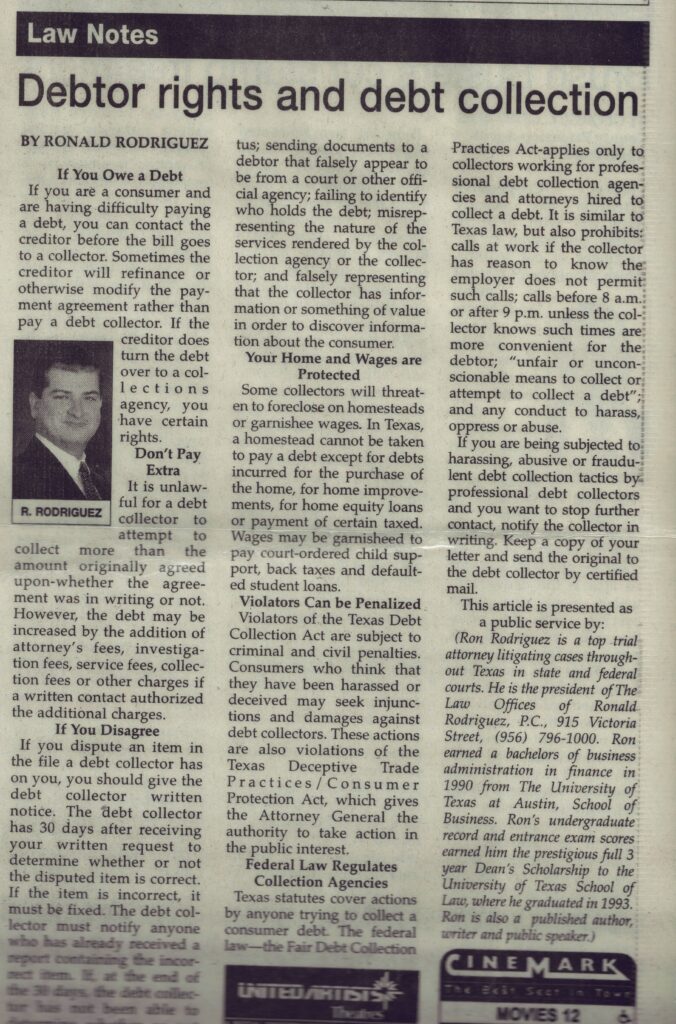
“Law Notes: Debtor rights and debt collection” article by Ronald Rodriguez
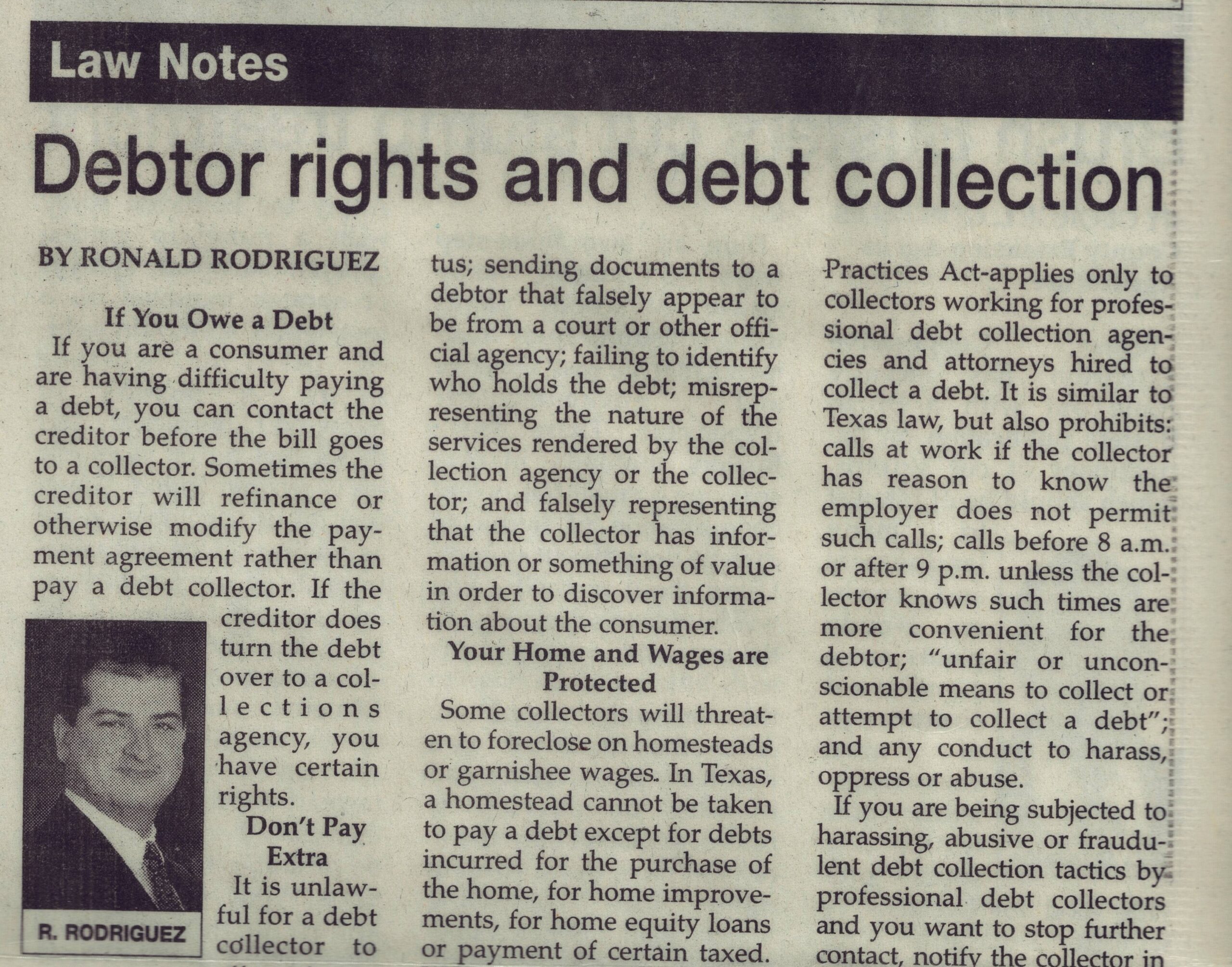
Law Notes: Debtor rights and debt collection
By Ronald Rodriguez, Laredo Morning Times
If You Owe a Debt
If you are a consumer and are having difficulty paying a debt, you can contact the creditor before the bill goes to a collector. Sometimes the creditor will refinance or otherwise modify the payment agreement rather than pay a debt collector. If the creditor does turn the debt over to a collection agency, you have certain rights.
Don’t Pay Extra
It is unlawful for a debt collector to attempt to collect more than the amount originally agreed upon, whether the agreement was in writing or not. However, the debt may be increased by the addition of attorney’s fees, investigative fees, service fees, collection fees, or other charges if a written contract authorized the additional charges.
If You Disagree
If you dispute an item in the file a debt collector has on you, you should give the debt collector written notice. The debt collector has 30 days after receiving your written request to determine whether or not the disputed item is correct.
If the item is incorrect, it must be fixed. The debt collector must notify anyone who has already received a report containing the incorrect item.
If, at the end of the 30 days, the debt collector has not been able to determine whether or not the item is correct, the collector must make the change you requested and notify anyone who received a report containing the incorrect item.
If it is later determined that the item was correct after all, you must be notified and collection efforts may be continued.
Harassment is Prohibited
State law prohibits the use of harassing and abusive collection tactics. It is illegal for any debt collector to:
- threaten violence or other criminal acts
- use profane or obscene language
- falsely accuse the consumer of fraud or other crimes
- threaten arrest of the consumer
- threaten repossession or seizure of property without proper court proceedings
- use the telephone to harass debtors by calling anonymously or making repeated or continuous calls
- make collect telephone calls without disclosing the true name of the caller before the charges are accepted
Fraud and Deception are Illegal
The use of fraudulent or deceptive practices is also prohibited, including:
- using a false name or identification
- sending documents to a debtor that falsely appear to be from a court or other official agency
- failing to identify who holds the debt
- misrepresenting the nature of the services rendered by the collection agency
- falsely representing that the collector has information or something of value in order to discover information about the consumer
Your Home and Wages are Protected
Some collectors will threaten to foreclose on homesteads or garnish wages. In Texas, a homestead cannot be taken to pay a debt except for debts incurred for the purchase of the home, for home improvements, for home equity loans, or payment of certain taxes.
Wages may be garnished to pay court-ordered child support, back taxes, and defaulted student loans.
Violators Can Be Penalized
Violators of the Texas Debt Collection Act are subject to criminal and civil penalties. Consumers who think that they have been harassed or deceived may seek injunctions and damages against debt collectors. These actions are also violations of the Texas Deceptive Trade Practices / Consumer Protection Act, which gives the Attorney General the authority to take action in the public interest.
Federal Law Regulates Collection Agencies
Texas statutes cover actions by anyone trying to collect a consumer debt. The federal law — the Fair Debt Collection Practices Act — applies only to collectors working for professional debt collection agencies and attorneys hired to collect a debt.
It is similar to Texas law, but also prohibits calls at work if the collector has reason to know the employer does not permit such calls, calls before 8 a.m. or after 9 p.m. unless the collector knows such times are more convenient for the debtor, “unfair or unconscionable means to collect or attempt to collect a debt,” and any conduct to harass, oppress, or abuse.
If you are being subjected to harassing, abusive, or fraudulent debt collection tactics by professional debt collectors and you want to stop further contact, notify the collector in writing. Keep a copy of your letter and send the original to the debt collector by certified mail.
About the Author: Ronald Rodriguez
Ronald Rodriguez is a nationally recognized Texas personal injury trial and appellate attorney, legal educator, and author whose career has been defined by major verdicts, appellate victories, and a strong commitment to justice.
Mr. Rodriguez is Board Certified in Personal Injury Trial Law and Civil Appellate Law by the Texas Board of Legal Specialization. This rare dual certification sets him apart. It allows him to not only build powerful cases at trial, but also protect and sustain those results on appeal.
He is also an adjunct professor at the University of Texas School of Law, where he teaches Texas Personal Injury Trial Law. This is the first class of its kind, and his textbook, the Texas Personal Injury Trial Law Handbook, serves as the foundation for the course. His role in teaching future attorneys reflects a deep level of knowledge and leadership in the field.
Mr. Rodriguez is the founder and managing attorney of Texas Personal Injury Experts, PLLC, a leading personal injury law firm with offices in Austin and Laredo. The firm represents individuals and families in high-stakes cases involving catastrophic injuries, wrongful death, and complex litigation.
A Proven Record of Results
Throughout his career, Mr. Rodriguez has secured numerous multimillion dollar verdicts and has been involved in some of the most significant cases in Texas.
His results include:
- A $281 million jury verdict, one of the largest in Texas
- A $47.5 million verdict against a private prison company
- Recognition as Trial Lawyer of the Year by the National Public Justice Foundation
- Induction into the Texas Lawyer Jury Verdict Hall of Fame
His work has also been featured in major national publications, including The New York Times, The Wall Street Journal, Bloomberg News, Texas Lawyer, and Lawyers USA.
Author of the Texas Personal Injury Trial Law Handbook
Mr. Rodriguez is the author of the Texas Personal Injury Trial Law Handbook, a comprehensive and practice-oriented guide to personal injury litigation in Texas.
The handbook provides a start to finish breakdown of the personal injury process, including:
- Case evaluation and early investigation
- Medical records and insurance communications
- Settlement demands and legal strategy
- Discovery and pretrial preparation
- Trial presentation and jury charges
- Post-trial motions and case resolution
Each chapter includes practical forms and real-world insight, making it a valuable resource for both legal professionals and individuals seeking to better understand their case.
Why His Perspective Matters
What sets Mr. Rodriguez apart is his combined experience in trial law, appellate law, and legal education.
Clients benefit from:
- Trial strategies built to withstand appellate review
- A deeper understanding of legal procedure and case development
- Experience handling high-stakes and complex litigation
- Insight shaped by teaching personal injury law at a top law school
This dual perspective allows for a more strategic and comprehensive approach to every case.
Learn From a Lawyer Who Teaches the Law
As a professor at the University of Texas School of Law, Mr. Rodriguez teaches the same concepts he applies in real cases.
This means clients and readers are learning from someone who not only practices law at a high level, but also teaches and refines those principles in an academic setting.
Thinking About Your Next Step
Understanding your rights is the first step. Having the right legal representation can make a meaningful difference in the outcome of your case.
If you or a loved one has been injured in Texas, Texas Personal Injury Experts provides strategic, client-focused representation backed by trial experience and appellate strength.
Call 833-300-0000 for a free case evaluation
No fee unless we win your case